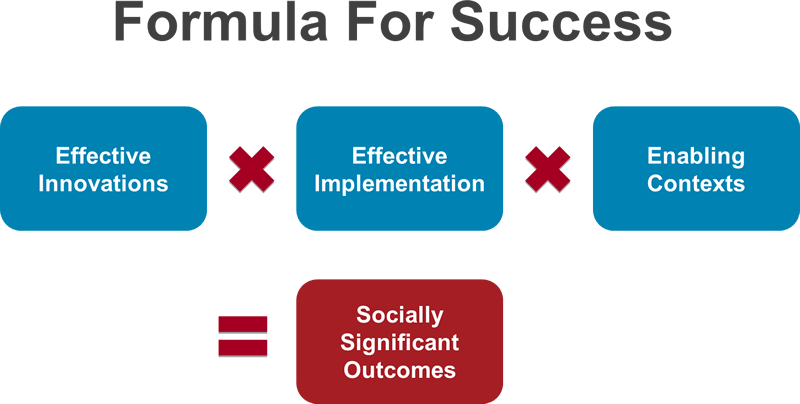
In the previous blog
post, the first of this three point series,
I began connecting coaching to the Implementation Science Formula for Success.
I presented a conundrum faced by coaches across the state--they are being
asked to implement the innovation without a system of support. In today’s post
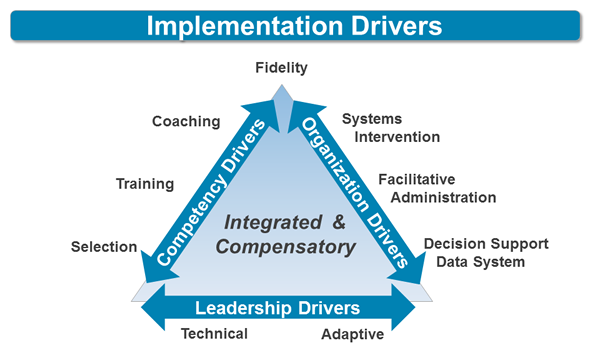
we will consider the Implementation Drivers and how their development is
essential to supporting coaching.
When the innovation of coaching is supported by the system
drivers located on the outside of the triangle, the likelihood that coaching
will be implemented to fidelity increases. Drivers are considered, both
integrated and compensatory, because they must all work together as a support
net (i.e., integrated); however if one is more weakly established, the others
will compensate (i.e., compensatory).
Let’s
begin by considering the competency drivers along the left side of the
triangle: Selection, Training, and Coaching
Selection, Training, and Coaching
Selection of coaching staff is a critical cornerstone, but
in my travels around the state of Wisconsin I find that it is given little
consideration. All too often good teachers are put into coaching roles
under the assumption that they will also be good coaches. The thought being that “good teachers make
good coaches”. In one example, an educator showed up to start the New
Year as a classroom teacher only to be placed in a coaching role without
consultation or training.
A district that is achieving high levels of success through
their coaching program, decided to open available coaching positions for anyone
to apply. This meant that individuals within or outside of the district
knew what they were committing to.
Furthermore, the district carefully crafted job description under which
the coaches would operate. This simple, yet essential, document is often
missing from many coaching systems. In
the same district, once staff was selected they received initial and ongoing
training to support their instructional coaching work. It is important to
collect some type of data to determine training needs. In my experience much of the training
available to coaches circles around building trust and conversations within a
coaching cycle. These skills are
absolutely necessary, but what is available to the coach that has already built
relationships and is ready to move past coaching
light? The final competency driver is
coaching. Coaches need coaches too!
Coaching can be a very isolated position and it is important to have
networking opportunities. This can be achieved by creating peer coaching
programs or hiring an external coach.
Last summer I visited a district that had a comprehensive
learning plan for their coaching team. They met monthly and spent part of
each day engaging in whole group learning before breaking into smaller study
groups to cover content they had selected as necessary to their growth.
Coaches were engaged in training and meaningful dialogue with other
coaches. Coaching of coaches is critical
in the implementation of the innovation of coaching in order for coaching to
obtain socially significant outcomes.
Decision Support Data System, Facilitative Administration,
and Systems Intervention
The
second set of drivers to consider is the organizational drivers. Systems
interventions are considered by a district-level team and consider if
policies/practices and funding align to the district vision, mission and action
plan. When coaching is new, funding will often be a topic of
consideration. How will the new position
be funded? How will the funding be continued?
Facilitative Administration relates to creating a culture where the new
innovation will be received. It is a rare occurrence to have a successful
coaching program without the support of leadership. At the minimum, leadership must be aware of
the research and promote the coaching model to staff. In some of the strongest programs I’ve seen,
leaders themselves will engage in a coaching cycle of their own. The use
of data in making decisions is crucial to the ongoing improvement of
coaching. Anecdotal data seems to be the
most common data source for coaches with teacher testimonials centered on a
coach’s accomplishments. Another data
that may be regarded is student outcome data.
These data sources are both worth considering; however when taken as
single sources, they don’t always tell the entire story. Other data
sources may include teacher surveys, coach observations and coaching logs. Best practice would have the leadership team
consider various sources to triangulate the data.
Technical and Adaptive Leadership
The
final set of drivers is in regards to leadership. I cannot
emphasize enough the importance of a supportive leader in building systems of
support for coaching. Technical leadership speaks to management. This is
the where there is general agreement about what needs to be done and an
understanding of how to do it (i.e., compliance). Unlike with “technical
leadership” (i.e., management), adaptive leadership seems to bring with it less
certainty. This work of changing
culture, which is a tenant of adaptive leadership, is “messier”; mainly because
this is where conflict lives. We know
that human beings struggle with change and the reaction to change can range
from emotional to resistant. Therefore,
leaders must have the skills, persistence, and heart to lead through and past
this resistance. While both types of leadership are necessary to support
the system, leaders with strong adaptive leadership styles result in the
highest implementation with fidelity.
At first glance, establishing systems
for coaching may seem overwhelming. After all, it does require a lot of
intentional work. However, when
considered through implementation stages, the work begins to take an evergreen
shape, and even seems more manageable along the way. In the next, and
final post of the series, I will work through the steps within the stages of
implementation to establish a robust system of coaching.